


National Geographic 2001 March
Publisher: National Geographic
Format: Paperback
ISBN: none
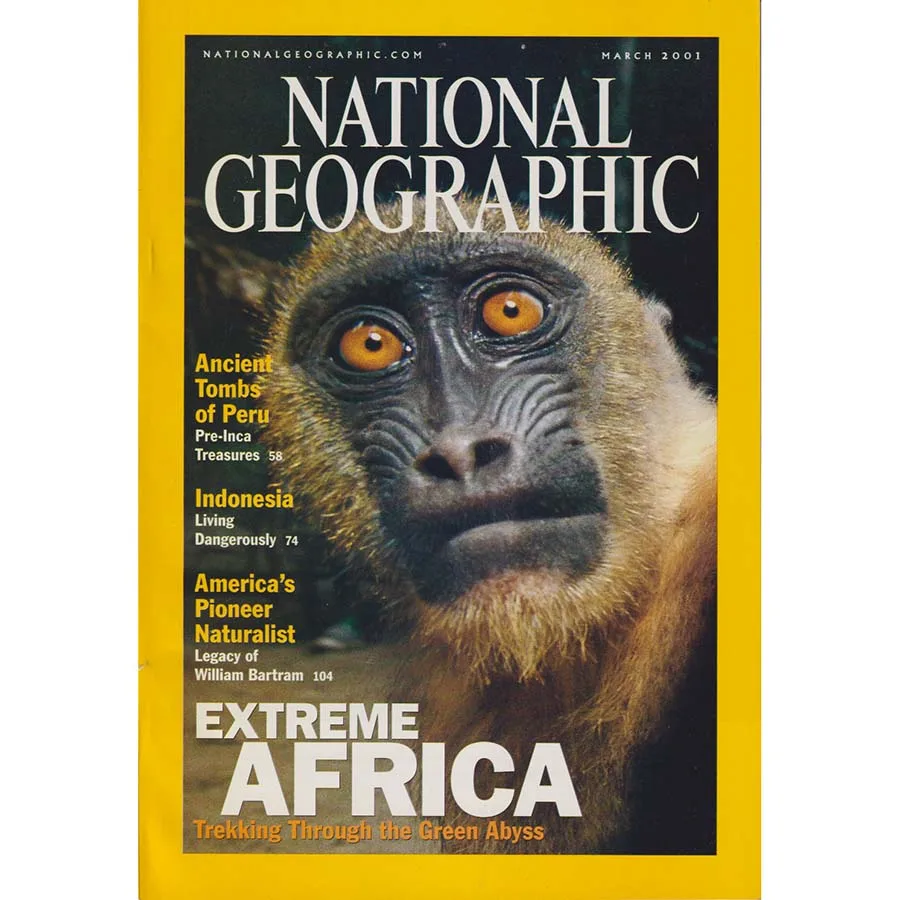
National Geographic, March 2001: the issue that makes eye contact with you from across the room and refuses to blink until you agree to go trekking somewhere humid, complicated, and probably full of insects with opinions.
The cover is dominated by Extreme Africa: Trekking Through the Green Abyss, which sounds like either a heroic expedition or a polite way of saying, “Welcome to the jungle, you will be damp now.” And then there’s that primate stare—wide, amber eyes that radiate pure, ancient judgement, as if the rainforest itself has borrowed a face to ask why humans insist on wandering into places that are perfectly happy without us. It’s equal parts gorgeous and faintly accusatory, which is very much the National Geographic brand at its best.
Inside, the “green abyss” delivers what it promises: lush density, survival logistics, biodiversity that doesn’t care about your timetable, and the kind of field reporting where every sentence smells slightly of wet leaves and adrenaline. It’s a reminder that “extreme” doesn’t always mean icy peaks and heroic panoramas; sometimes it’s heat, shadow, and the relentless fact that nature in full voice is not designed for your comfort. This is exploration as persistence: you don’t conquer the forest, you negotiate with it—mostly by sweating and hoping your boots hold out.
And because Nat Geo never lets you sit in one place for long (emotionally or geographically), the rest of the issue is a neatly packed world tour of danger, wonder, and intellectual nosiness. You’ve got Ancient Tombs of Peru: Pre-Inca Treasures, which is archaeology with that familiar ticking-clock undertone: beautiful things buried, and people above ground who would really like to steal them. It’s the romantic lure of lost civilisations… plus the less romantic reality of looting and preservation battles.
Then there’s Indonesia: Living Dangerously, which in 2001 could mean about twelve different things—volcanoes, earthquakes, politics, geography, all of it layered like the archipelago itself. It’s one of those Nat Geo features that quietly teaches you what “risk” looks like when it’s not a weekend hobby but just… Tuesday.
You also get America’s Pioneer Naturalist: The Legacy of William Bartram, a calmer, lovelier counterpoint—an ode to the kind of exploration that involves notebooks, curiosity, and the patient act of noticing. It’s a reminder that the world isn’t only “extreme” when it’s trying to kill you; sometimes it’s extreme in its detail, its beauty, and its sheer refusal to fit neatly into human categories.
Condition: Good, which is perfect for a 2001 issue: sturdy, readable, and still capable of transporting you back to the era when magazines were thick, glossy, and confidently unafraid of long articles. Sold by Crappy Old Books, naturally—because nothing pairs better with “trekking through the green abyss” than buying it from a place that sounds like it keeps its stock in teetering piles and mild chaos.
If you want classic early-2000s National Geographic—big nature, big journeys, ancient mysteries, and a primate on the cover silently questioning your life choices—this one’s a keeper. Open it up. The rainforest is waiting. And it definitely has the upper hand.
Keep browsing: See more National Geographic books Other books by National Geographic
